
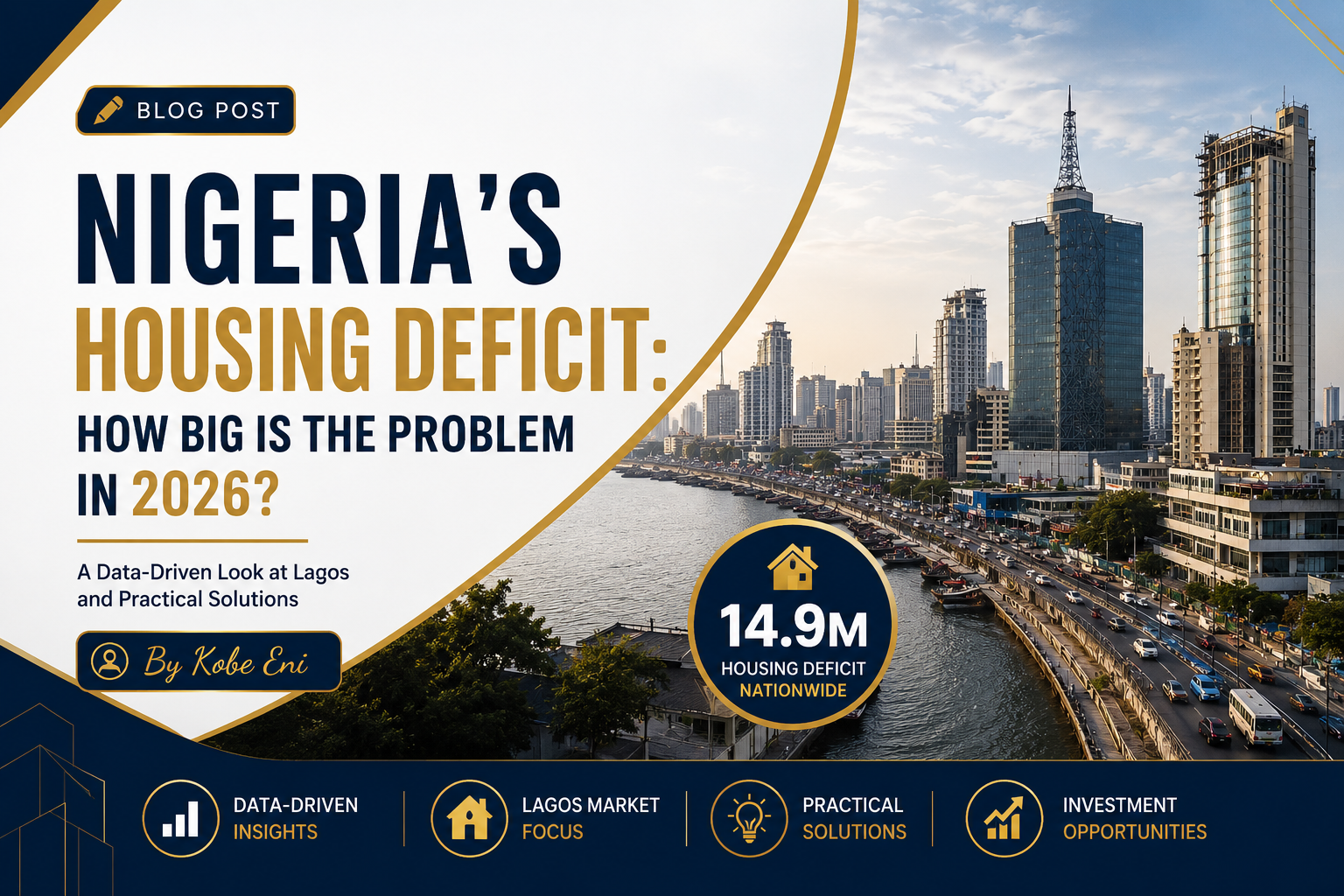
Nigeria’s Housing Deficit in 2026: Why Lagos Is Feeling the Pressure the Most
By Kobe Eni
Nigeria’s housing crisis is no longer just a talking point for economists or government agencies. In 2026, it has become a daily reality for millions of Nigerians especially in Lagos, the country’s commercial heartbeat. From skyrocketing rents in Lekki to overcrowded apartments in mainland areas like Yaba and Surulere, the housing problem is visible everywhere.
According to recent government-backed data, Nigeria’s housing deficit now stands at approximately 14.9 million housing units. While previous estimates often mentioned over 20 million units, this updated figure comes from a more structured and data-driven housing assessment.
But make no mistake — the reduction in numbers does not mean the housing situation has improved. It simply means the country now has more accurate data to measure the crisis.
And nowhere reflects this pressure more than Lagos.
Why Lagos Is the Centre of Nigeria’s Housing Crisis

Lagos is Nigeria’s economic engine. Every day, thousands of people move into the city searching for jobs, better opportunities, business growth, or simply survival.
The result? Housing demand is exploding faster than developers can build.
Reports estimate that Lagos alone has a housing deficit of over 2.7 million homes, making it one of Africa’s most pressured housing markets.
Areas that used to be considered “developing” like Sangotedo, Ajah, Epe, Ibeju-Lekki, and Alasia are now experiencing rapid land appreciation and rental demand because central Lagos has become too expensive for average earners.
Today in Lagos:
A decent mini-flat in Lekki Phase 1 can cost millions yearly
Service charges are increasing across estates
Young professionals are forced to live farther from work
Shortlets are reducing long-term rental supply in premium locations
As dem dey talk for street:
“House no dey finish for Lagos. Na who get money dey survive am.”
What Is Causing the Housing Deficit?
1. Population Growth and Urban Migration

Nigeria’s population continues to grow rapidly, and Lagos receives the biggest share of internal migration.
People move from different states into Lagos every day because:
More job opportunities exist
Businesses thrive faster
Infrastructure is better compared to many states
Real estate is seen as an investment opportunity
The challenge is simple:
More people are entering Lagos than the number of homes being built.
2. High Construction Costs
Building materials in Nigeria have become extremely expensive.
Developers now face rising costs for:
Cement
Iron rods
Tiles
Diesel
Labour
Imported fittings
Even basic finishing costs have doubled in some areas over the last few years.
This is why developers often focus on luxury apartments and high-end terraces where profit margins are higher.
Affordable housing? The returns are smaller and infrastructure costs remain heavy.
3. Land and Documentation Problems
Land administration remains one of the biggest challenges in Lagos real estate.
Many developers still face:
Delays in Governor’s Consent
Omo Onile disputes
Expensive title processing
Inconsistent regulations
Slow approval systems
These delays increase project timelines and overall costs.
For many small developers, documentation alone can frustrate an entire project before construction even starts.
4. Weak Mortgage System
In developed countries, people buy homes gradually through long-term mortgage systems.
In Nigeria, mortgage accessibility is still very limited.
Most Nigerians cannot afford:
High equity contributions
Double-digit interest rates
Strict banking requirements
So instead of owning homes, many remain lifelong renters.
How This Affects Everyday Lagos Residents
The housing deficit is not just a statistic. It affects real people daily.
Rising Rents
Landlords continue increasing rents due to strong demand.
Longer Commutes
Workers now live farther away from business districts because central areas are unaffordable.
Overcrowding
Multiple families often share apartments due to high costs.
Pressure on Infrastructure
Roads, drainage systems, electricity, and water supply become overstretched.
The Investment Side: Why Smart Investors Are Watching Lagos Closely
Interestingly, Nigeria’s housing crisis also creates major opportunities for investors.
Because demand is so high:
Rental properties remain attractive
Shortlets continue growing
Mid-income housing is expanding
Emerging locations are appreciating fast
Areas like:
Sangotedo
Ibeju-Lekki
Epe
Abijo
Alasia
Ajah
are seeing increasing investor activity because they offer relatively affordable entry points compared to Lekki Phase 1 or Ikoyi.
In simple terms:
“Where population dey go, money too dey follow.”
Realistic Solutions to Nigeria’s Housing Problem
1. Government Must Simplify Land Documentation
Reducing delays in:
C of O processing
Governor’s Consent
Building approvals
would significantly reduce housing costs.
Faster documentation = faster development.
2. More Affordable Housing Partnerships
The government cannot solve the crisis alone.
Private developers, investors, and financial institutions need stronger partnerships to create:
Affordable estates
Rent-to-own schemes
Flexible payment plans
3. Infrastructure Expansion Beyond Central Lagos

When roads, electricity, drainage, and transport systems improve in outer areas, people can comfortably live farther from the city centre.
This reduces pressure on expensive urban districts.
Projects like:
The Lagos-Calabar Coastal Highway
Lekki-Epe corridor expansion
New transport infrastructure
could reshape housing distribution in the future.
4. Better Mortgage Access
Nigeria needs:
Lower interest housing loans
Longer repayment periods
Easier qualification systems
Without affordable financing, homeownership will remain difficult for average Nigerians.
Final Thoughts
Nigeria’s housing deficit in 2026 is not just about missing buildings. It is about affordability, urban planning, infrastructure, and economic reality.
Lagos represents both the biggest challenge and the biggest opportunity.
While millions still struggle to find affordable housing, the demand itself creates long-term opportunities for developers, investors, and real estate entrepreneurs willing to think strategically.
The future of Lagos real estate will belong to those who can balance:
affordability,
infrastructure,
smart urban expansion,
and sustainable development.
Because one thing is certain:
Lagos is still growing — and people will always need somewhere to live.